

Ceiling microphones for conference rooms: overview, comparison, tips
Table of Contents
Why ceiling microphones are useful in modern conference rooms
Modern conference rooms should be flexible, tidy, and intuitive to use. Tangled cables on the table. Ceiling microphones offer an attractive alternative here: they disappear visually into the room, pick up speakers regardless of where they are seated, and can be seamlessly integrated into professional conference technology, video conferencing systems, and room control systems.
In this era of hybrid meetings and international conferences, reliable voice transmission is becoming a fundamental requirement. Ceiling microphones help ensure that all participants in the room and online can understand each other clearly without having to worry about the technology.
Arrange a free consultation on ceiling microphones in conference rooms
Market overview: Manufacturers and typical positioning
The market for ceiling microphones in conference environments is dominated by a few highly specialized manufacturers. They each offer product families that are often part of a larger ecosystem of DSP, loudspeakers, and control systems.
Shure – Microflex Advance (e.g., MXA901)
With the Microflex Advance series, Shure is primarily targeting professional meeting rooms and conference areas. The round ceiling array MXA901 offers beamforming in a compact, unobtrusive form factor and blends in well with modern office environments. Larger and technically demanding projects typically use additional models from the MXA series, combined with Shure DSPs and loudspeakers.
Link: https://www.shure.com/en-US/products/microphones/mxa901
Sennheiser – TeamConnect Ceiling (TCC2, TeamConnect Ceiling Medium)
With the Microflex Advance series, Shure is primarily targeting professional meeting rooms and conference areas. The round ceiling array MXA901 offers beamforming in a compact, unobtrusive form factor and blends in well with modern office environments. Larger and technically demanding projects typically use additional models from the MXA series, combined with Shure DSPs and loudspeakers.
Link: https://www.shure.com/en-US/products/microphones/mxa901
Biamp – Parlé TCM‑X
With the Parlé TCM‑X ceiling microphones Biamp relies on very flat, inconspicuous arrays that have been specially developed for Tesira and Devio systems. At the heart of the system is beam tracking technology, which dynamically tracks speakers. Biamp also offers complete room solutions in which microphones, DSP, loudspeakers, and preconfigured presets are coordinated with each other.
Link: https://products.biamp.com/product-details/-/o/ecom-item/911.0498.900
Audio Technica – ATND1061
The ATND1061 is a beamforming ceiling array with up to six output channels and up to 32 freely definable pickup zones. This allows the room to be divided into zones very precisely, for example for fixed seating positions, presentation areas, or a speaker zone at the podium. Integrated DSP functions such as automix, echo cancellation, and noise reduction make the system attractive for installations where as little external signal processing as possible is desired.
Yamaha – RM CG in the ADECIA system
Yamaha is pursuing with ADECIA A system approach: The ceiling array RM-CG is part of a package consisting of a microphone, DSP, amplifier, and speakers. The solution is primarily aimed at conference rooms where a coordinated overall installation is desired. Dante audio and intelligent voice tracking functions ensure consistent voice pickup throughout the room.
Link: https://europe.yamaha.com/en/business/audio/products/microphones/rm-cg/
Sony – MAS A100
The MAS-A100 is an IP-based beamforming ceiling microphone that enables simultaneous voice amplification in the room and recording (e.g., for streaming, lecture capture). This dual-channel output makes the system particularly interesting for universities, training rooms, and corporate environments where lectures need to be recorded and amplified in the room at the same time.
Link: https://pro.sony/ue_US/products/microphone-array-system/mas-a100
ClearOne – BMA 360
With the BMA 360 ClearOne offers a ceiling tile array that can be used as a full-fledged ceiling tile in grid ceilings. The system is designed for larger conference and boardrooms and, in addition to beamforming, also offers features such as voice lift and connection to camera tracking solutions.
Technical concepts in comparison
Almost all of the systems mentioned today rely on beamforming or beam tracking, i.e., microphone arrays that combine multiple capsules to form a directional pickup pattern. The difference lies primarily in the type of control:
- beamforming works with defined, controllable „beams“ that are directed at specific zones or areas in the room.
- beam tracking actively tracks the person speaking and dynamically adjusts the direction without the need for predefined zones.
Systems such as the Shure MXA901, Sennheiser TeamConnect Ceiling solutions, Biamp Parlé, and ClearOne BMA 360 use these technologies to reliably capture speakers regardless of whether they are sitting, standing, or moving around the room.
In addition, many ceiling microphones have a integrated signal processing: Auto mixer, echo cancellation, noise reduction, and automatic gain control are often already integrated into the microphone or the associated platform. This reduces the need for external hardware and can simplify planning, provided that the interfaces to existing DSP or video conferencing systems are neatly resolved.
Products and services
LED solutions for conferences, events and companies. We rent, sell and take care of permanent installations and maintenance.

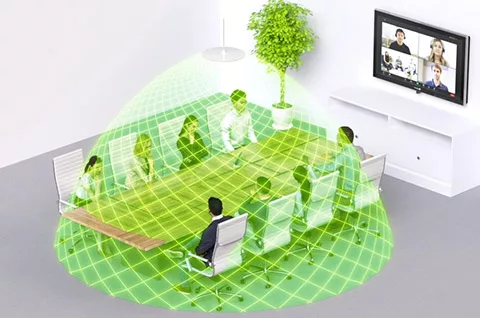
Optimal audio coverage is our starting point and the most important factor in...
Selection based on room size and usage scenario
When selecting the right ceiling microphone, it is not so much the technical specifications that are decisive, but rather the Room type and desired use:
- Small to medium-sized meeting rooms often benefit from a single ceiling array such as the Shure MXA901, the Audio-Technica ATND1061, or a Biamp Parlé TCM-X. The installations remain manageable, and speakers can move freely around the room.
- Traditional conference rooms and larger meeting rooms Depending on the room geometry, one or more – arrays are required. This is where Sennheiser TeamConnect Ceiling 2, ClearOne BMA 360, or Yamaha ADECIA solutions come into their own. In addition to pure voice recording, integration into video conferencing platforms, room control, and camera tracking are often required.
- Lecture halls, training rooms, and hybrid event spaces pose special challenges: In addition to range and speech intelligibility, aspects such as speech amplification in the room and recording/streaming are also important. Systems such as Sony MAS‑A100 or Sennheiser TeamConnect Ceiling 2 are therefore often used in combination with media technology for lecture capture and hybrid events.
In addition to room size and usage scenario, the following factors also play a role Ceiling construction, acoustics, and budget Open ceilings or difficult acoustics usually require more precise planning and, if necessary, acoustic measures to exploit the full potential of modern ceiling microphones.
Conclusion
Ceiling microphones have become established in professional conference environments because they elegantly combine technology and interior design. Whether compact beamforming arrays such as Shure MXA901 and Biamp Parlé, powerful ceiling panel solutions such as Sennheiser TeamConnect Ceiling or ClearOne BMA 360, or system-oriented approaches such as Yamaha ADECIA and Sony MAS-A100 –, there are suitable solutions for almost every type of room and every usage scenario.
By considering room geometry, acoustics, existing conference technology, and future requirements for hybrid meetings at an early stage, you can lay the foundation for an installation that takes the strain off participants and ensures relaxed, clear conferences in the long term.